
If you’re buying property in Brisbane, knowing the median price only tells you part of the story.
What really matters is what your budget can buy in the locations you’re considering, and what compromises, opportunities or trade-offs come with it.
A $1.5 million budget might buy a renovated character home in one pocket of Brisbane, a near-new house further out, or something very different again close to the bay. That’s because there isn’t one Brisbane property market. New Farm behaves differently to Wishart. Cleveland is different again. And the property type, land, aspect, condition, street position and even the individual pocket within a suburb can materially affect value.
Each quarter, Home Scouts looks at recent sales and market conditions across eight key precincts spanning Greater Brisbane, Moreton Bay and Redlands to provide a practical guide to what different budgets can buy.
Important: The figures and examples below are intended as a guide to purchasing power, not property valuations. Individual properties can vary significantly depending on their location, land, condition, layout, views, aspect, improvements and other property-specific factors.
Brisbane opened the spring selling season with a clear shift in the balance of power toward buyers. Cotality’s Property Market Indicator for the week ending 6 September 2026 shows Brisbane’s preliminary auction clearance rate at just 24.8%, the second lowest of the year and a steep drop from 74.8% at the same time last year. Only 133 homes went under the hammer, down 8.9% on the previous week and 7.6% down on a year ago.
Values have followed a similar path. Brisbane dwelling values fell 0.2% over the week and 1.1% over the month, though the market remains up 2.7% year to date and 10.3% over the past 12 months, a clear moderation from the double-digit annual growth seen earlier in the cycle. Listings have opened up considerably to match: Brisbane currently has 14,637 total properties for sale, up 53.3% on a year ago, with 3,634 new listings hitting the market in the past four weeks alone. That’s giving buyers meaningfully more choice, and more negotiating room, than they had this time last year. On the rental side, Brisbane’s median rent sits at $742 a week, up 6.4% over the past 12 months, with gross yields easing slightly to 3.4% and vacancy rates ticking up to 2.0%.
And this is where the headline numbers become less useful.
Current 12-month house medians sit at around $3.76 million in New Farm (a figure skewed upward by a handful of very high sales, with the suburb’s underlying value closer to $2.4 million), roughly $2.6 million in Teneriffe, around $1.78 million in Camp Hill, about $1.45 million in Coorparoo, close to $1.50 million in both Wishart and Mansfield, around $1.5 million in Sunnybank, roughly $1.13 million in Cleveland, around $1 million in Victoria Point, about $1.01 million in Redcliffe and close to $1.18 million in North Lakes.
Even those figures need to be treated carefully. A median doesn’t tell you whether the next property at that price is a renovated Queenslander, a near-new build, a townhouse or an apartment.
That’s why we think it’s more useful to ask:
What can your budget actually buy?
A genuine foothold in Redlands and Moreton Bay, and units or smaller townhouses in tightly held inner suburbs
A meaningful range of established and standard family homes across the middle-ring suburbs
Good quality family homes in sought-after pockets, larger land in outer areas, and stronger access to premium inner suburbs
Premium family homes, better locations, larger blocks and selected inner-city opportunities
High-end riverside, character and prestige property, though position remains critical

New Farm and Teneriffe remain two of Brisbane’s most tightly held inner-city markets, but they shouldn’t be treated as one homogeneous pocket. New Farm’s 12-month median house price sits at around $3.76 million, although that figure is pulled well above the market’s typical centre by a small number of very high-value sales; a more representative estimate for the suburb currently sits closer to $2.4 million. Teneriffe’s median house price is around $2.6 million, with the suburb having recorded exceptionally strong annual growth off the back of a run of premium sales.
At around $1.5 million, buyers are generally looking at apartments or smaller character properties requiring some compromise. Around $2 million starts to open up more residential choice, while $3 million-plus moves buyers into the area’s more premium riverside pockets.
Our take
New Farm and Teneriffe are markets where scarcity matters enormously. At the higher end, buyers aren’t simply paying for bedrooms or land size. They’re paying for attributes that are difficult or impossible to replicate: river frontage, walkability to James Street and the Powerhouse, heritage character and proximity to the CBD.
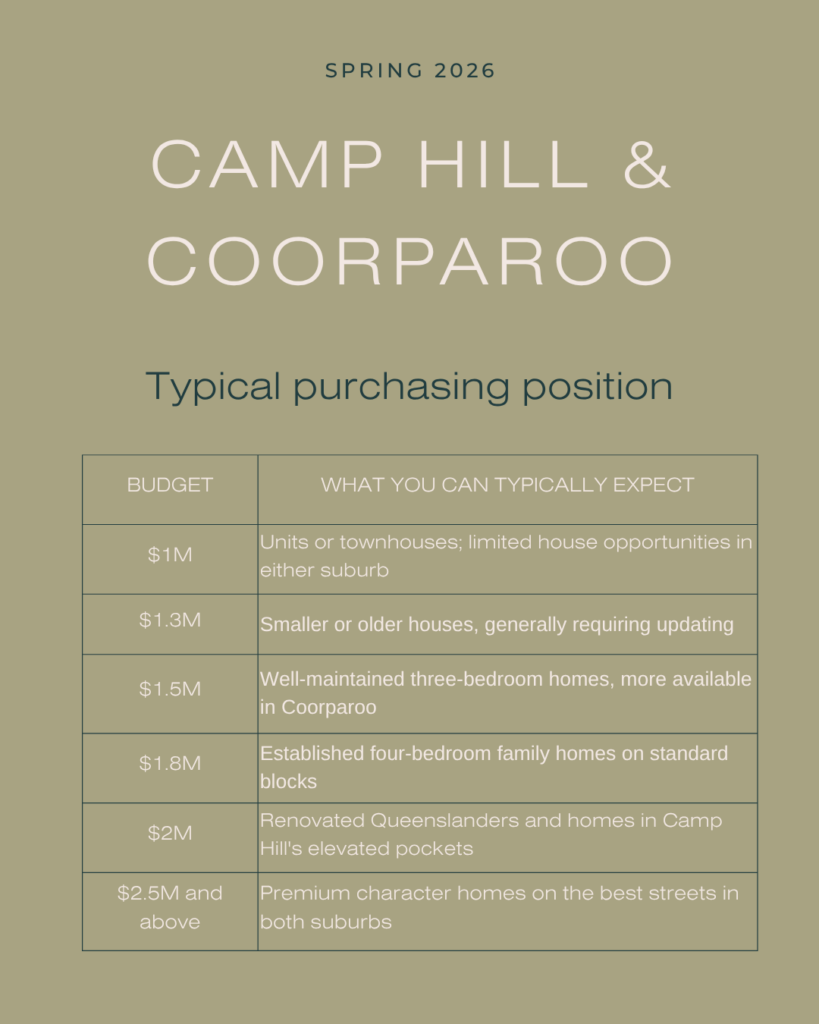
These two inner south-east suburbs sit right next to each other but offer quite different propositions. Camp Hill’s median house price is currently around $1.78 million to $1.99 million depending on the data source, reflecting a suburb of elevated, character-filled streets with strong owner-occupier demand. Coorparoo’s median sits lower, at around $1.45 million, with renovated Queenslanders on the elevated streets between Cavendish Road and Old Cleveland Road pushing well past $1.9 million.
Around $1.5 million, Coorparoo generally offers more choice, while Camp Hill’s premium hilltop pockets increasingly require a budget closer to $2 million. Recent Coorparoo settlements illustrate the spread well: a five-bedroom home on Kanumbra Street sold for $1,720,500 in June, while a smaller three-bedroom house on Wylie Avenue changed hands for $1,430,000 in July.
This pairing is a good example of how micro-location drives value more than suburb boundaries. A beautiful kitchen can be changed. A great elevated position with a north-facing block generally can’t and buyers who understand that difference make better decisions here.
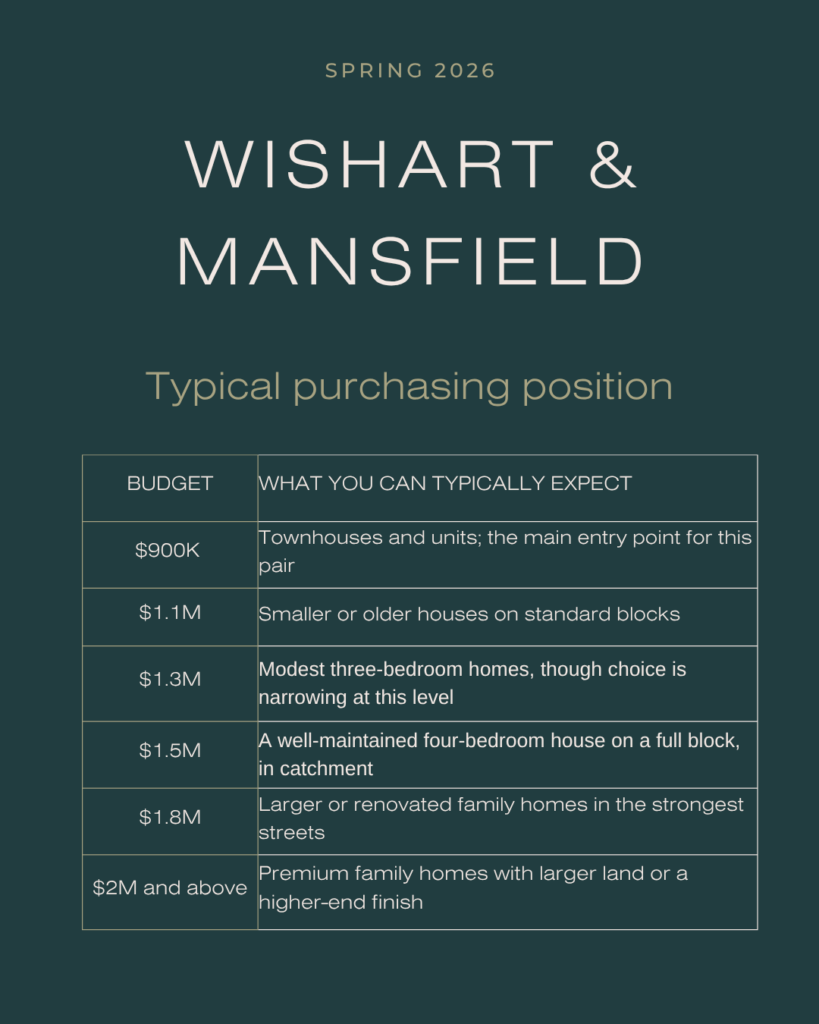
Wishart and Mansfield sit around 14 kilometres south-east of the CBD and have become two of Brisbane’s more consistent family markets, both anchored by sought-after state high school catchments. Wishart’s median house price is currently around $1.5 million, up more than 11% over the past year, while Mansfield sits at a very similar level, also around $1.5 million, up over 20% annually.
At this budget, buyers can typically secure a well-maintained four-bedroom house on a full block. Below $1.3 million, choice narrows to smaller or older homes, while townhouses and units provide a more accessible entry point from the high $800,000s. A recent example: a four-bedroom, two-bathroom home on a 660m² block in Hurlstone St, Wishart sold for $1,500,000 in May, right in line with the suburb’s current median.
These suburbs reward buyers who prioritise school catchments and land size over inner-city proximity. Properties here are selling quickly, generally within three weeks and good family homes are attracting genuine competition.
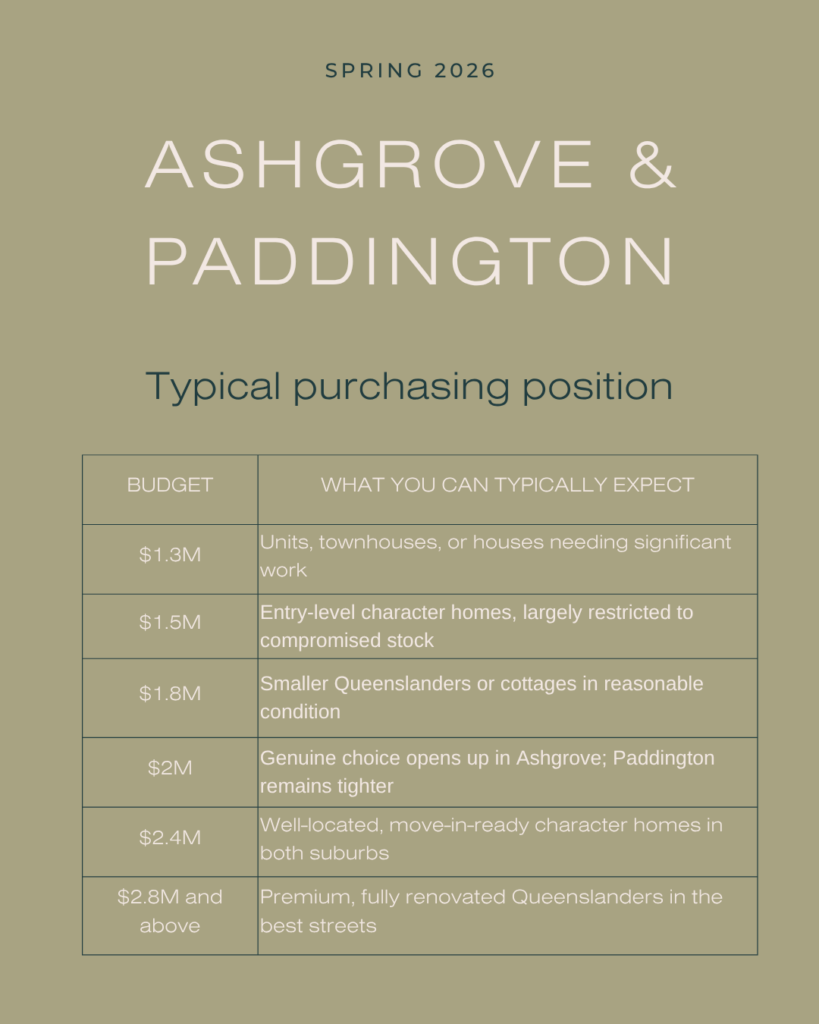
Ashgrove and Paddington are two of Brisbane’s most tightly held inner-west character precincts, both built almost entirely on Queenslander housing stock and both consistently short of listings. Ashgrove’s median house price currently sits around $1.9 to $1.99 million, up roughly 4 to 10% over the past year depending on the data source, with houses typically taking under a month to sell. A four-bedroom home on Brown Parade sold last month for $2,385,000 on a 607m² block, well above the suburb median and a sign of how much premium a good block and street still command. Paddington sits a step higher again, with a median house price around $2.15 to $2.24 million; however, a four-bedroom character home on Cochrane Street sold for $3 million also in August, 2026.
At around $1.5 million, buyers are largely restricted to units, townhouses or homes needing significant work in both suburbs. Around $2 million opens up genuine choice in Ashgrove, while Paddington increasingly requires a budget closer to $2.2 million or above for a well-located, move-in-ready character home.
Ashgrove and Paddington are markets where supply, not demand, sets the price. With house sales numbering only in the low hundreds each year across both suburbs, well-presented character homes in good pockets routinely go under contract after the first or second open home, and buyers who hesitate tend to pay more for a lesser property a few weeks later.
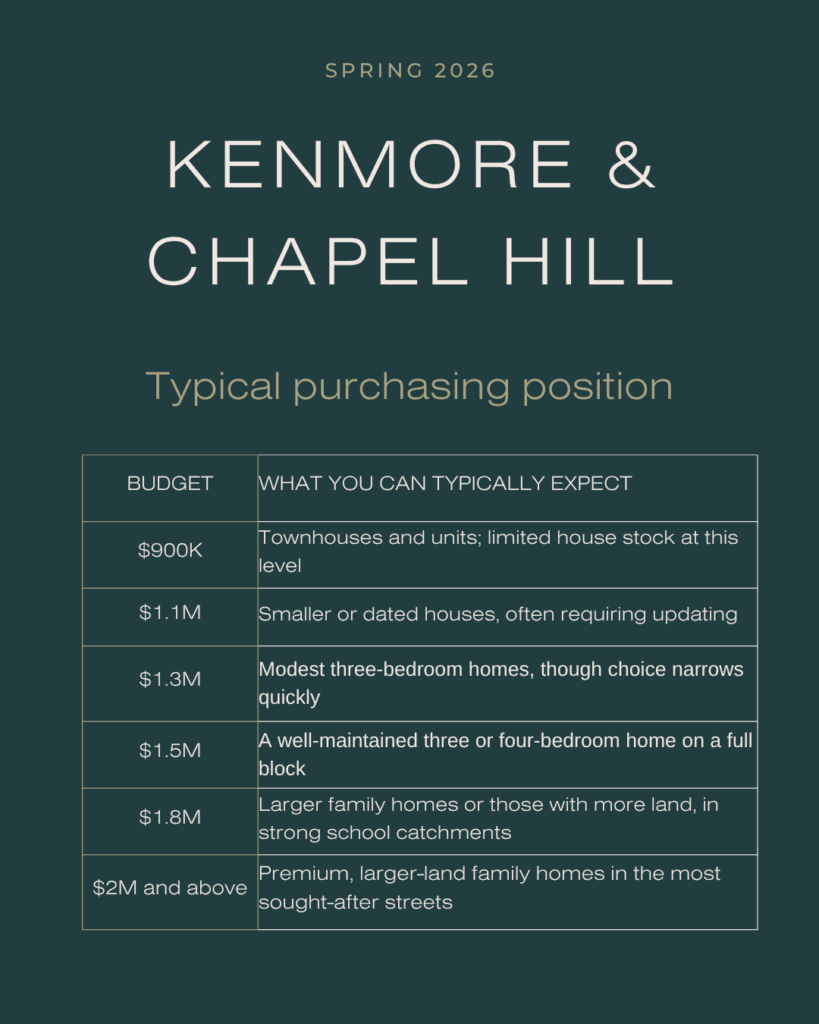
Kenmore and Chapel Hill sit around 10 kilometres west of the CBD and have built a reputation as two of Brisbane’s most reliable family markets, underpinned by strong schools, proximity to the Brisbane River and the Western Freeway corridor. Kenmore’s median house price currently sits around $1.4 to $1.7 million depending on the data source, up roughly 8% over the past year. We recently secured a young family’s purchase of a four-bedroom home on Belford Street, Kenmore, for $1,525,000 at auction. Chapel Hill sits at a broadly similar level, with a median house price around $1.6 million, up close to 9 to 11% annually, and one of the shortest average times on market of any suburb in this guide at around two weeks.
At around $1.4 to $1.6 million, buyers can typically secure a well-maintained three or four-bedroom home on a full block in either suburb. Below $1.3 million, choice narrows to smaller homes or those needing updating, while premium, larger-land properties in both suburbs are increasingly moving past $1.8 million.
Kenmore and Chapel Hill reward buyers who move decisively and do their homework before, not after, they fall in love with a property. Both suburbs are recording extremely short average days on market, and in our own experience representing buyers here, thorough due diligence before an offer, not after it’s accepted, has been the difference between a good outcome and a costly one.
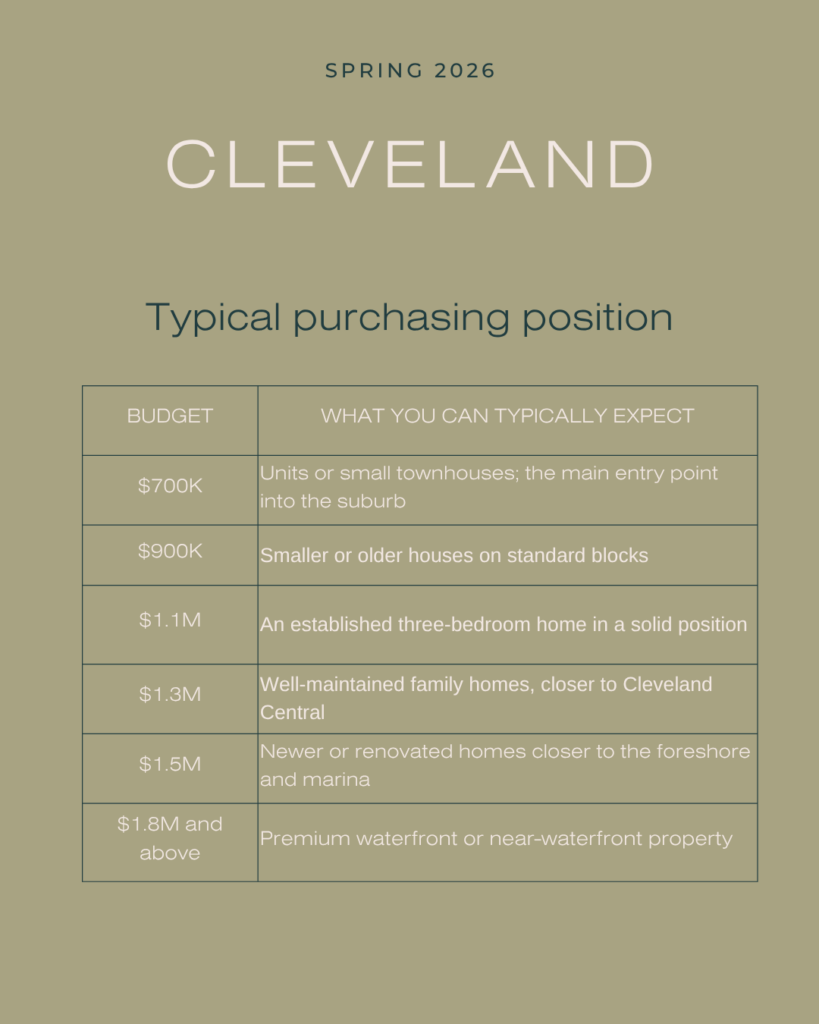
Cleveland, the administrative heart of Redland City, has become one of the bayside’s standout performers. The suburb’s median sold house price over the past 12 months sits at around $1.13 million, with properties typically taking around three weeks to sell and roughly 60% of homes selling over their listed price, a clear sign of continued buyer competition.
At around $1 million, buyers can generally access an established three-bedroom home in a solid position, while budgets from $1.4 million upward open up newer or renovated homes closer to the foreshore, marina and Cleveland Central precinct, like the 4-bedroom home in Longland St that recently sold for $1,439,000.
Our take
Cleveland’s appeal lies in its combination of genuine bayside lifestyle and functioning town centre. Buyers shouldn’t assume every property here is a beach shack; the spread between a basic three-bedroom home and a renovated foreshore property is significant.
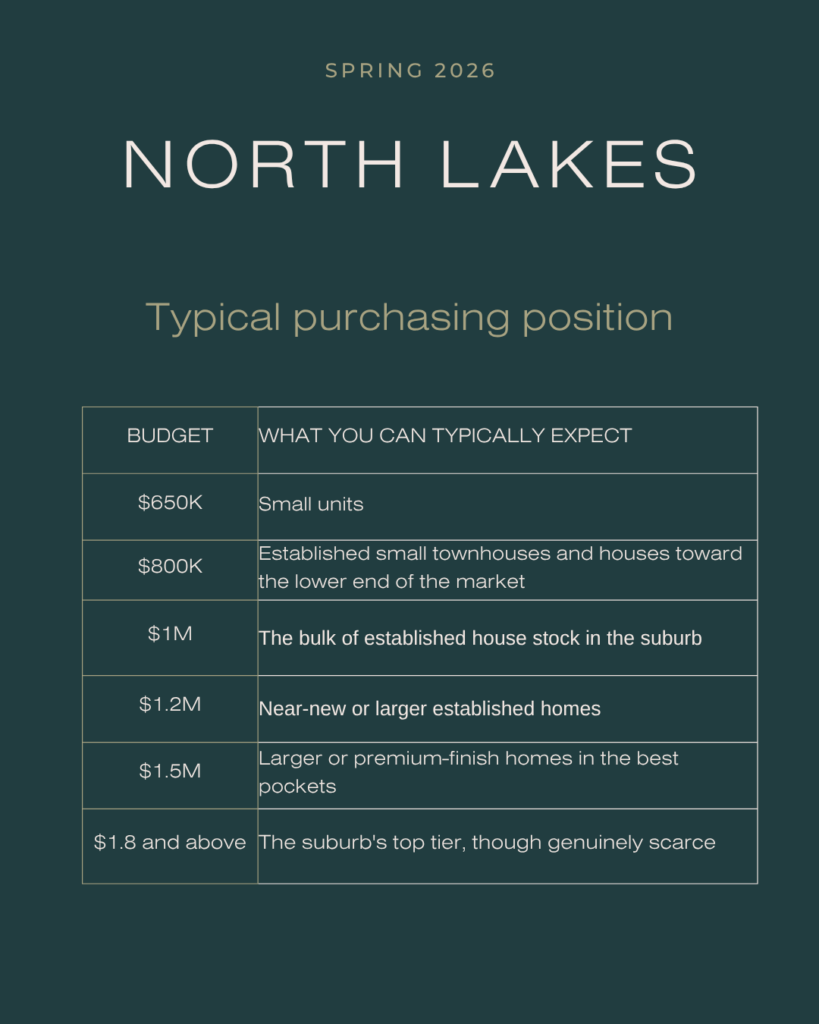
North Lakes has firmly established itself as Moreton Bay’s benchmark master-planned community, and its property market reflects that maturity. The suburb’s current median house value sits at around $1.18 million, up more than 23% over the past year, one of the strongest growth rates of any suburb in this guide. Homes are selling in around 13 days on average, well ahead of the broader Moreton Bay pace.
The bulk of house sales fall between $800,000 and $2 million, with the majority clustering between $800,000 and $1 million for established stock and $1 million to $1.5 million for near-new or larger homes. A recent example: a four-bedroom home on Grebe Circuit sold for $1,460,000 in September, at the upper end of the suburb’s typical range.
North Lakes demonstrates how infrastructure and amenity can reshape a suburb’s trajectory. Buyers who bought here even three or four years ago have seen substantial gains and the suburb’s position near planned 2032 Olympic venues at Petrie and Redcliffe is likely to keep it firmly on buyers’ radars.
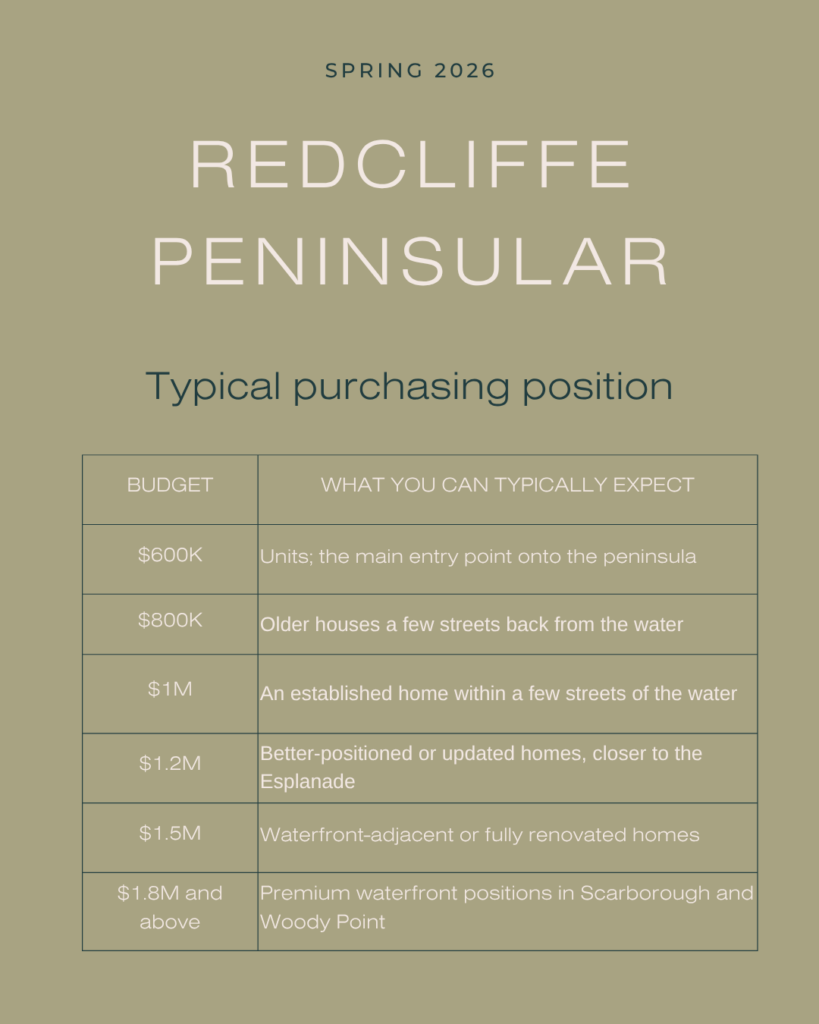
Redcliffe has shifted markedly over the past few years from an affordable, retiree-heavy market to a genuine lifestyle destination, helped along by the Redcliffe Peninsula rail line and ongoing Moreton Bay infrastructure investment. The suburb’s median house price currently sits at around $1.01 million, up close to 23% over the past year, while units trade at roughly $820,000.
At around $900,000 to $1 million, buyers can typically secure an established home within a few streets of the water. Premium waterfront positions in Scarborough and Woody Point, just along the peninsula, command a clear step up in price. Sales activity through the first half of the year has been strong, with local agents reporting a steady run of properties selling within four to six weeks of listing. More recently, a four-bedroom home on Herbert St, Scarborough, sold in August for $1,450,000.
Redcliffe is a market where the water is doing a lot of the work. Proximity to the Esplanade and clear water views can add hundreds of thousands of dollars to an otherwise comparable home just a few streets back.
The big story this quarter isn’t simply whether Brisbane prices have risen or fallen. It’s that buyers now have genuine choice for the first time in several years, with total listings up 53.3% on a year ago and the auction clearance rate sitting at just 24.8%, well below the 74.8% recorded this time last year. But we’re not seeing a simple, across-the-board shift in behaviour. The result is a market where good properties can still attract strong competition, while compromised properties are sitting longer and requiring more negotiation.
“What we’re seeing this quarter from the inner city right through to the bay, is that buyers have stopped chasing anything with a price tag. A well-positioned home with good fundamentals can still attract multiple offers, while buyers are far more willing to walk away when the numbers don’t stack up against the alternatives just down the road.”
Sandra Connors, Home Scouts
At Home Scouts, our Brisbane buyers agent helps interstate and local buyers navigate the Greater Brisbane property markets with clarity and confidence.
By combining deep local knowledge, careful due diligence and strategic negotiation, we help buyers secure the right property – often before the broader market even sees it. If you’re considering buying in 2026/2027, now is the time to start planning your approach.