
Where is the Sunshine Coast in the property cycle?
It’s a question we’re asked regularly – but there’s one problem with it. There isn’t one Sunshine Coast property market, so there isn’t really one Sunshine Coast property cycle either.

At any given time, a renovated family home on usable land in Buderim can be experiencing very different buyer demand from an apartment in Maroochydore. Noosa Heads can behave differently from Peregian Springs. Entry-level properties can move differently from prestige homes.
Understanding property cycles can provide useful context for buyers. But understanding the micro-market within that cycle is where things become much more useful.
Property markets typically move through different periods over time. Strong buyer demand can produce rising prices and increased competition. Eventually affordability, interest rates, increased supply or changing confidence may slow that momentum.
These cycles are influenced by a range of forces – and they don’t affect every property market equally, or at exactly the same time.
The Sunshine Coast isn’t a traditional metropolitan property market. It’s a collection of coastal, lifestyle, family, employment and hinterland communities, each with different housing stock, buyers and supply constraints – and demand comes from several sources at once: interstate relocators, retirees, families, investors and lifestyle buyers, alongside an established local population.
The Sunshine Coast has long attracted people looking for a different way of life. But “lifestyle demand” doesn’t mean every Sunshine Coast property performs equally – a buyer wanting to walk to the beach in Buddina has a very different brief from a family wanting usable land in Buderim, or someone wanting to walk to Hastings Street in Noosa Heads.
Historically, the Sunshine Coast was heavily associated with tourism, construction and retirement. Today the economic base is considerably broader – health and medical employment around the Sunshine Coast University Hospital precinct, education, professional services, technology, and the development of Maroochydore City Centre are all contributing to a more diverse local economy.
You’ll often hear that the Sunshine Coast has “limited land”. That’s broadly true in established coastal and hinterland locations, but it’s important not to oversimplify. The more interesting question for buyers is how easily more of a particular type of property can be created in a particular location.
Imagine four properties coming onto the market at exactly the same time – a renovated family home on usable land in a tightly held Buderim pocket, an older apartment requiring substantial renovation near the beach, a modern house in an area with significant new housing supply, and a premium Noosa property in a tightly held location.
All four are technically part of the “Sunshine Coast property market”.
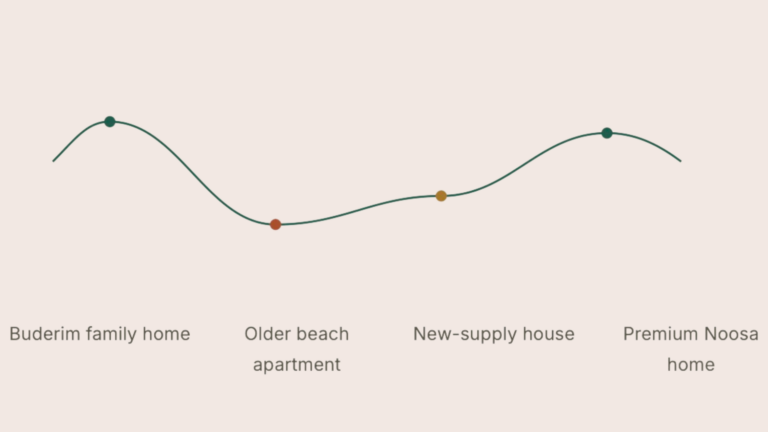
But their buyer pools, scarcity, price sensitivity and competition could be completely different.
One may attract multiple buyers immediately. Another may sit on the market for weeks. One vendor may achieve a premium result. Another may need to adjust their expectations. That’s why median prices and regional headlines only tell part of the story – property cycles play out suburb by suburb, pocket by pocket and property by property.
In our work with buyers across the Sunshine Coast and Noosa, we regularly see significant differences between properties that look similar on paper. A well-positioned home with genuine scarcity can attract strong competition even when broader market conditions appear softer, while more substitutable properties can sit on the market for longer. That’s why we assess the individual property, its immediate surroundings, comparable sales and future supply rather than relying solely on suburb-level headlines.
You may sometimes hear investors and agents describe properties as “A-grade”, “B-grade” or “C-grade”. It isn’t an official classification – more a useful guide for thinking about how different properties are likely to behave through a cycle.
Well-located, genuinely hard to replicate, wanted by owner-occupiers and investors alike. Tends to hold value better in softer conditions, because demand keeps returning even when supply doesn’t.
A good property, but with more like-for-like alternatives nearby. Can perform just as well as A-grade in a strong market – usually the first to feel it when conditions soften, simply because buyers have more to compare it against.
Dated presentation, a difficult block, a busy road, or a suburb with considerable new supply coming online. Typically the most exposed to a changing market, and the slowest to recover when conditions turn.
Going back to the earlier examples – the renovated Buderim home on usable land, and the tightly held Noosa property, both lean A-grade – part of why they’re holding demand. The ageing apartment and the new-supply house both carry more C-grade characteristics, which helps explain why they’re behaving so differently in the same market, at the same time.
Grade isn’t fixed, either. A property’s position can shift with condition, presentation, local supply, or simply time – which is exactly why the individual property, not the suburb label, is what matters most.
You'll hear agents and buyers talk about "A-grade," "B-grade" and "C-grade" properties. They're not official ratings — just a useful shorthand for how a property sits on location, quality, growth potential, price and the objections a typical buyer would raise. Run a property through the five questions below to see how it stacks up.
This just personalises your results — nothing is saved or sent anywhere.
This quick check uses the A/B/C shorthand buyers hear about. When we're working with you on a purchase, we go further — assessing value, quality, suitability, risk and opportunity, backed by proper due diligence, against your own Buyer Brief, not a generic checklist.
Trying to perfectly time a property market sounds wonderful in theory.
Unfortunately, the market doesn’t usually announce the bottom until after it has passed. By the time the data clearly shows conditions have strengthened, good properties may already be attracting greater competition.
That doesn’t mean buyers should rush – there are good reasons to wait. But waiting for certainty is different from waiting strategically.
How much stock is available – is supply increasing, or are suitable properties genuinely difficult to find?
How strong is buyer competition – are quality properties attracting multiple buyers while compromised homes remain available?
What’s happening to vendor expectations – selling around, above, or below asking?
What are comparable properties actually selling for – not asking prices, actual transactions?
Which property types are most tightly held, and is there future supply that could change that?
Who’s buying – locals, interstate relocators, downsizers, investors, or lifestyle buyers?
Strong markets can disguise poor buying decisions.
When prices are rising quickly, compromised properties can rise too – but when markets become more selective, those compromises become much more visible. The market shouldn’t be your strategy. The property itself still needs to stack up.
There isn’t one answer, because there isn’t one Sunshine Coast market. Some pockets and property types are in strong demand right now, while others are softer – the more useful question is what’s happening in the specific area and property type you’re actually looking at.
That depends far more on your own readiness – finances, brief, timeline – than on trying to time the broader market. Waiting for certainty is different from waiting strategically, and the right time to buy is usually when the right property, at the right price, meets your own circumstances.
They’re informal shorthand, not an official classification. Broadly, A-grade properties are scarce and broadly appealing and tend to hold value through softer conditions; B-grade properties are solid but more substitutable; C-grade properties carry a genuine compromise and are usually the most exposed when a market changes.
Markets rarely announce the bottom until after it’s passed – by the time the data confirms conditions have turned, good properties are often already attracting more competition again. There are good reasons to wait, but they’re usually personal ones, not an attempt to perfectly time the market.
Each suburb, and often each pocket within it, has its own buyer pool, supply levels and scarcity. A tightly held pocket with genuine owner-occupier appeal can behave very differently from a suburb with considerable new housing supply coming online, even a few kilometres away.
It can – more competing stock generally gives buyers more to compare a property against, which tends to soften demand for similar existing homes nearby. The effect varies by location and quality, so it’s worth understanding what’s realistically likely to be built near a specific property, not just the suburb generally.
Lifestyle migration is a genuine, ongoing driver of demand in many parts of the region. But it doesn’t lift every property or suburb equally – the effect is strongest where a property or location has broad, cross-market appeal.
Look past the headline and check the fundamentals for that specific property: genuine scarcity, quality and condition, how it compares to actual recent sales (not asking prices), and whether it would appeal to a broad range of future buyers, not just you.
A local buyers agent can help you read what’s actually happening at the micro-market level – supply, competition, comparable sales – rather than relying on regional headlines that may not reflect the specific property or pocket you’re considering.
Whether you’re buying a home, relocating to the Sunshine Coast or investing, our Sunshine Coast buyers agent can help you understand what’s happening at a local level and assess individual properties through the lens of value, quality, suitability, risk and opportunity.